
Why Remodel Costs Differ by Orange County Neighborhood
Two homeowners can request the exact same kitchen remodel — same square footage, same finishes, same layout — and receive estimates that differ by tens of thousands of dollars. The reason isn’t guesswork or inconsistent pricing. It’s location.
Sea Pointe Design & Remodel has spent almost 40 years remodeling homes across Orange County, from coastal Laguna Beach to inland Rancho Santa Margarita, and that experience means we understand exactly why costs shift from one zip code to the next. Below is a breakdown of what actually drives those differences, and how our design-build model keeps your budget accurate from the first estimate.
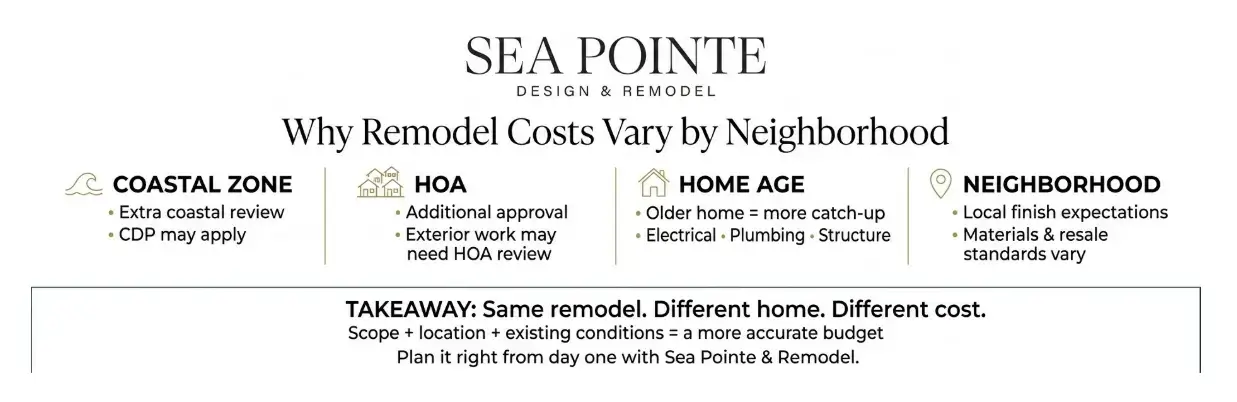
What Coastal Zone Status Adds to a Remodel
A CDP Isn’t Automatic, But It Is Often Separate
A coastal remodel does not automatically mean a homeowner must go directly through the California Coastal Commission, but the property’s location can introduce an additional layer of review that an inland project may not face. Under the California Coastal Act, development within the Coastal Zone generally requires a Coastal Development Permit (CDP) unless an exemption applies.
A CDP may be issued by the Coastal Commission or, in areas covered by a Commission-certified Local Coastal Program (LCP), by the local city or county. The Commission explains that most CDP authority is delegated to local governments after an LCP is certified, while the Commission retains jurisdiction over certain areas and appeal authority over specified projects.
Why This Isn’t a Simple “City Permit vs. Coastal Permit” Choice
This means a coastal remodel should not be viewed as a simple “city permit versus Coastal Commission permit” choice. A project might follow the local building and planning process and also require a coastal development determination, permit, exemption, or other coastal review depending on its location and scope.
The Coastal Commission’s own enforcement program overview confirms that a CDP requirement runs independently of, and in addition to, other city, county, state, or federal permits that may apply to the same project. For homeowners, the practical difference is that exterior additions, alterations, decks, grading, or other work affecting a coastal property may require additional documentation before construction can begin.
Why Early Identification Matters More Than the Permit Itself
Identifying whether a separate CDP applies early in planning is the step that avoids delays, unnecessary costs, and violations later. Waiting until after a design is finalized to discover a coastal review is required often forces a homeowner back to the drawing board, which costs far more than simply asking the question up front.
This is one of the clearest examples of why remodel costs aren’t really about geography in the abstract — they’re about which regulatory bodies a given property answers to, and how early that gets sorted out. A well-run design-build process treats this as a first-week question, not something discovered mid-permit.
HOA Density Changes the Approval Process
Sequential Review, Not Parallel Review
Orange County has one of the highest concentrations of homeowners associations in the country, and HOA architectural review typically runs as a separate step from city permitting, not in parallel with it. Master-planned communities in cities like Irvine, Mission Viejo, and Rancho Santa Margarita often require HOA sign-off before a permit application can even move forward.
This sequencing affects cost in a less obvious way than materials or labor: it affects time, and time is money on a construction schedule. A remodel in a non-HOA neighborhood can sometimes break ground faster simply because there’s one less approval body involved before work begins.
What HOA Guidelines Typically Restrict
Beyond timing, HOA guidelines often dictate exterior paint colors, roofing materials, fencing styles, and even window configurations, which can limit design choices that would otherwise be available in a non-HOA neighborhood. Homeowners sometimes discover these restrictions only after falling in love with a specific exterior finish that their association doesn’t allow.
Interior remodels are usually far less affected by HOA review than exterior work, since most associations focus their guidelines on what’s visible from the street or shared common areas. Knowing this distinction early helps homeowners understand which parts of their project need extra lead time and which don’t.
Home Age and Housing Stock Drive Structural Costs
Older Neighborhoods Often Need Infrastructure Catch-Up
Older, established neighborhoods like parts of Santa Ana, Orange, and San Juan Capistrano often come with older electrical panels, outdated plumbing, and foundations that weren’t built to current code. Bringing these systems up to today’s standards adds cost that a newer build in a master-planned community wouldn’t need.
This is rarely visible until a wall is opened. A homeowner budgeting purely for cabinetry and countertops can be surprised by the added cost of rewiring a panel or replacing galvanized pipe, simply because their home predates the plumbing and electrical standards a newer property was built to meet.
Newer Construction Shifts the Budget Toward Design
Newer construction in cities like Ladera Ranch or newer Irvine villages tends to already meet current code on the systems level, which means remodel dollars go further toward finishes and design rather than infrastructure catch-up. This is one of the biggest reasons two “identical” kitchen remodels can carry very different price tags depending on the home’s age.
It’s also why a fixed, one-size-fits-all price quote rarely holds up in Orange County. A contractor who hasn’t inspected a home’s existing systems is essentially guessing at half the budget, regardless of how detailed the finish selections look on paper.
Neighborhood Finish Expectations Shift the Budget
Coastal and Master-Planned Communities Set a Higher Baseline
Home values vary significantly across Orange County, and buyer expectations tend to follow. In higher-value coastal and master-planned communities, quartz countertops, engineered hardwood, and integrated smart-home features are often treated as a baseline rather than an upgrade, which raises the starting point for material selections.
This isn’t about homeowners in these areas being pickier — it reflects what tends to hold value at resale in that specific market. A remodel that undershoots local finish expectations can actually underperform on return, even if the workmanship is excellent.
More Flexibility in Other Neighborhoods
In neighborhoods with a wider range of home values, homeowners often have more flexibility to choose mid-range materials without it affecting resale expectations. Neither approach is right or wrong — it simply means the “right” finish level is partly a function of the neighborhood a home sits in, not just personal preference.
This is one of the more subjective cost factors on this list, but it’s also one where a designer’s local market knowledge saves homeowners from either overspending unnecessarily or underspending relative to what their neighborhood actually supports.
How Sea Pointe Prices Your Project Accurately From Day One
This is exactly why a generic remodel estimate rarely holds up once a designer actually walks your home. Sea Pointe’s design-build process pairs your designer with a dedicated project manager and estimator from the earliest planning stages, so your budget reflects your city’s permitting realities, whether that’s a coastal CDP determination, an HOA architectural review, or your home’s age, before a single wall comes down.
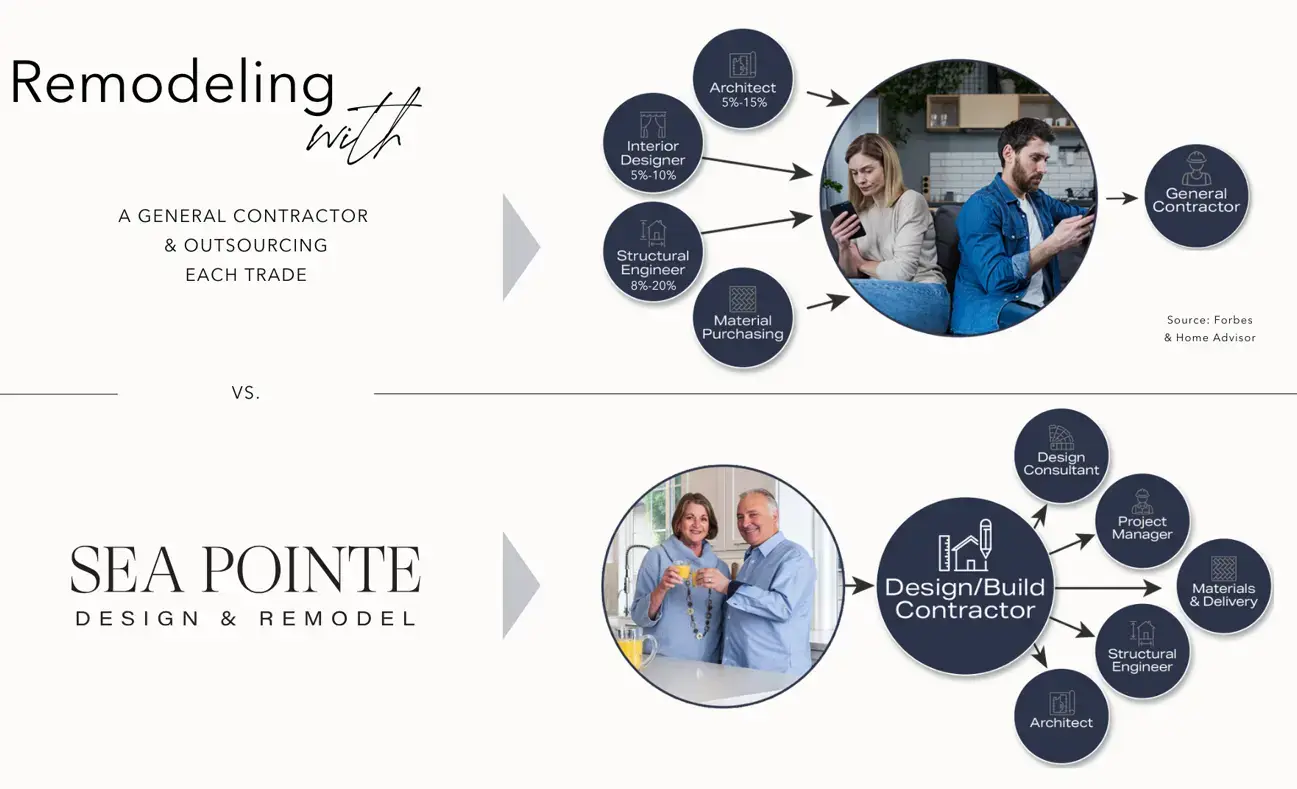
That single point of accountability is part of why more than half of our business comes from repeat clients and referrals. Whether you’re remodeling a coastal kitchen in Laguna Beach or a whole-home renovation in Mission Viejo, our team has already priced and permitted projects like yours in your exact neighborhood, and you can see where we’ve built across the county.
Get an Estimate Built Around Your Actual Neighborhood
Remodel costs aren’t one-size-fits-all across Orange County, and a generic online estimate can’t account for your city’s permitting process, a coastal review requirement, or your HOA’s timeline. Sea Pointe’s design-build team prices every project around the realities of where you actually live.
Schedule your complimentary in-home consultation today by calling (949) 861-3400, or visit seapointe.com to get started.
Does being in the Coastal Zone always mean I need a Coastal Commission permit?
Not necessarily. Many coastal areas have a certified Local Coastal Program, meaning the city or county — not the Commission directly — issues the Coastal Development Permit.
Is a Coastal Development Permit the same as my city building permit?
No. A CDP is a separate, additional requirement from standard city or county building permits, though both processes may run alongside each other on the same project.
Do HOA requirements really affect my remodel budget?
Yes, indirectly. HOA architectural review adds a sequential approval step before permitting can proceed, which extends timelines and can add planning costs, especially for exterior work.
Does the age of my home affect remodel pricing?
Significantly. Older homes often need electrical, plumbing, or structural upgrades to meet current code, which adds cost beyond the visible remodel work.
Does a coastal remodel always cost more than an inland one?
Not automatically. Being in the Coastal Zone doesn’t guarantee higher costs, but it can add a regulatory review step that needs to be identified before pricing and scheduling.
Is a remodel in a master-planned community more expensive?
Not necessarily more expensive overall, but finish expectations tend to run higher in these communities, which can raise the starting budget for materials.
Can Sea Pointe give me an accurate estimate for my specific neighborhood?
Yes. Our estimators and designers factor in your city’s permitting process, coastal review status, HOA requirements, and home age from the first consultation.