SCHEDULE YOUR COMPLIMENTARY CONSULTATION

SCHEDULE YOUR CONSULTATION

"*" indicates required fields

This field is for validation purposes and should be left unchanged.
Optin

"*" indicates required fields

This field is for validation purposes and should be left unchanged.
Optin
Kitchen Remodel Planning Guide: Where to Start & What to Expect

Kitchen Remodel Planning Guide: Where to Start & What to Expect

Kitchen Remodeling Guide

The decision to remodel a kitchen or bath is not a spur of the moment epiphany. Most of our clients spend considerable time researching, investigating options and imagining the tremendous joy that will come with a completely remodeled space. Inspiration comes from varied sources ranging from home improvement television shows to a neighbor’s made over home. The journey from concept to completion is rarely as easy as what is depicted on reality television shows. As much as we would like a remodel to take only few days or weeks at a budget that is a pipedream, reality dictates that home improvement doesn’t work that way. Most home improvement shows are produced to inspire homeowners to make renovations and buy products featured on those shows.

Step 1: Dream

The best place to start your kitchen remodel is to identify the features, benefits, looks and feelings that you want to achieve with your remodel. Visit online resources such as Houzz.com, Pinterest, Décor and Architectural Digest magazine among others to collect ideas. When presented with color schemes, textures and looks that you want to achieve, a professional designer can develop a plan that fits almost any budget. Determine what your goals are, the functionality you are looking for and how you want your new kitchen to look and feel. If you had an unlimited budget, what would your new kitchen or bath look like and how would it perform?

Step 2: Establish Priorities

The first step in establishing priorities is to develop a realistic budget. This is an area where a professional showroom consultant can be a trusted advisor. We help our clients determine renovation budgets that are not only realistic, but also in keeping with goals, aspirations and dreams. How much should you budget? That depends on the nature and scope of your renovation. On average, homeowners report that a kitchen remodel costs close to $20,000. A smaller project, one that includes cabinet re-facing, sink replacement, installation of a tile backsplash and a fresh coat of paint can range from $10,000 to $25,000. A $30,000+ renovation may include semi-custom cabinets, hardwood floors, granite counters and higher-end appliances. You may spend more than $100,000 on a complete overhaul with structural changes, custom cabinets, stone countertops, top-of-the-line appliances, etc. Pricing guides you find online are based on averages and sometimes can be misleading. That’s why establishing priorities is essential to develop a realistic budget.

Step 3: What You Should Expect From a Professional Showroom

When selecting a showroom to partner with, make sure that the showroom is experienced with the type of renovation that you want. Ensure that the installation crews and subcontractors involved on the project are licensed and insured and that the showroom has a performance record of staying within timeframes and budgets. Ask for references you can call to determine firsthand the quality and level of service that a showroom provides. Also when you do move forward with a professional, be sure that terms, conditions and payment obligations are detailed in a written and signed contract.

Step 4: Have Realistic Expectations

There is no such thing as a typical or problem-free kitchen renovation. Full-scale renovations are likely to leave you without a functioning kitchen for an extended time period. Our showroom offers guidance for creating temporary kitchens or cooking areas that eliminate the need to eat out or order take out for every meal.

Renovations are messy, so ask your showroom what steps they take to minimize dust, dirt and other unpleasant aspect of the renovation process.

Finally, the timeline will take longer than most expect. Contrary to what is shown on home improvement television, it completely unrealistic to expect a bathroom to be remodeled in a weekend or a kitchen be redone in a week, even if you are placing cabinets, floors, countertops, appliances, lighting and floor and wall coverings exactly where they currently exist.
Let's Discuss Your Next Project!

  • This field is for validation purposes and should be left unchanged.
  • We guarantee 100% privacy for all information!

Kitchen Remodel Planning Guide: Where to Start & What to Expect was last modified: December 18th, 2025 by Smart Marketing
How to Maximize Small Spaces

How to Maximize Small Spaces

Remodeling Design Guide

How to Maximize Small SpacesKitchens are not as large as they once were. The kitchen and home footprint are contracting as a rule and open floor plans are becoming the norm. We love to design open floor plan kitchens, but an open floor often means losing a wall of cabinets, which makes it a challenge to provide ample storage. We love challenges!
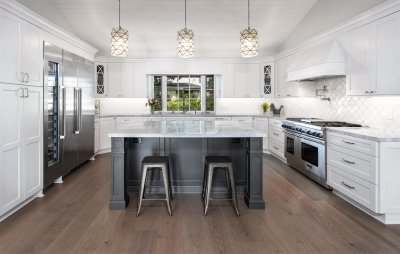
When space is an issue, our first thoughts are to ensure that the finished product is both functional and aesthetically wowing. For functionality, we envision an imaginary straight line drawn from the center of the sink, to the center of the cooktop, to the center of the refrigerator and finally back to the sink. In the trade, this is referred to as the work triangle. As a rule of thumb, no leg of the triangle should be less than 4 feet or more than 9 feet. Concurrent in configuring the best triangle, we also think about  kitchen storage solutions.

Islands are enormously popular with our clients, but they are not always the best solution, especially if space is limited, because they can make it difficult to maneuver in the space. Alternatives to islands include u-shaped designs or peninsulas to provide both storage and countertop space. We also use multitasking principles and products to maximize the effectiveness of the kitchen when space is at a premium. This can be accomplished by:

  1. Keeping countertops at seat height instead of bar stool height, which enables the countertop to serve dual purposes of a dining area and work area
  2. Specifying appliances that serve dual roles such as refrigerators that have the ability to convert between fridge and freezer or combination ovens that can function as a convection, conventional and speed
  3. Creating bar areas that can be used for organization and entertaining
  4. Specifying multifunctional islands that serve as dining and work areas
  5. Installing pullout pantries or cabinets that serve as pantries
  6. Using nonstandard sized cabinets
  7. Extending cabinets to the ceiling and countertops
  8. Hanging pot racks from the ceiling
  9. Taking advantage of in-cabinet storage solutions such as vertical tray dividers, roll out shelves and trays
  10. Specifying smaller or alternative appliances, e.g., columnar refrigerators or refrigerator or a speed oven in lieu of microwave

Don’t believe that a small space can’t make for a great, functional and aesthetically pleasing kitchen. Let us show you how!

Let's Discuss Your Next Project!

  • This field is for validation purposes and should be left unchanged.
  • We guarantee 100% privacy for all information!

How to Maximize Small Spaces was last modified: December 18th, 2025 by Smart Marketing
Custom Kitchen Cabinet Storage

Custom Kitchen Cabinet Storage

Popular & Practical Cabinet Inserts

Custom Kitchen CabinetsWhen clients come to our Orange County showroom, they expect to see cabinets with beautiful finishes, quiet operations and lots of functionality. However, the combination of form and function is the starting point. And in today’s competitive environment, manufacturers of cabinet components are constantly breaking new ground in almost every category ranging from adjustable hinges that operate without making a sound to interior storage products that make life so much easier. The following products scratch the surface of infinite possibilities for your new kitchen.

  • Custom-made aluminum framed doors inspired by European modern trends offer clean lines and innovative materials offered in a series of different inserts and profiles.
  • Concealed drawer runners that enable drawers to be opened with a tap of the finger and close without making a sound.
  • Hinges that allow doors to open to a 165-degree angle and that close doors evenly and gently thus eliminating the possibility of trapping your finger in the door regardless of the drawer’s position.
  • Systems that make it easy to backlight islands, backsplashes, countertops, cabinets or walls.
  • A spring-loaded, soft close appliance lift that enables you to mechanically raise a small appliance (weighing up to 45 pounds) from a base cabinet to the just below counter height. Once raised, the lift locks in place to steady the appliance when it use. Perfect for the baker in every family.
  • Lazy susan systems that maximize storage in corner cabinets and protects cookware from scratches.
  • In-drawer and under-counter docking stations to charge smart phones and tablets.
  • Pullout shelves for blind corner cabinets that create new storage opportunities.
  • Pullout spice racks that put functionality into filler space.
  • Knife block drawer inserts that save both drawer and countertop space and can fit into almost any sized drawer.

There are hundreds of products that can make a beautiful kitchen more functional and stylish. If you are interested in making your kitchen easier and more enjoyable to use, expanding kitchen storage space without moving a wall or improving the organization of your cutlery, cookware and other kitchen components, please give us a call at (949) 861-3400 or visit our showroom at  576 Wald, Irvine, CA 92618.

Let's Discuss Your Next Project!

  • This field is for validation purposes and should be left unchanged.
  • We guarantee 100% privacy for all information!

Custom Kitchen Cabinet Storage was last modified: December 18th, 2025 by Smart Marketing
A Different Take on Countertops – Remodeling Design Guide

A Different Take on Countertops – Remodeling Design Guide

Countertop Design Guide

Most clients are familiar with common countertop materials such as marble, granite or quartz. However, those popular options by no means limit a palate or choices. Other popular countertop materials include;

Laminate (Formica, Wilsonart, Devmar and others)

Laminate is cost effective, comes in hundreds of colors and patterns and is easy to clean and maintain.

Wood (Butcher Block)

Wood is a living product that will change over time. Wood will show wear and tear, nicks and scratches; it is not heat resistant and needs to be sealed regularly. The attractiveness of wood is its ability to add character and warmth to a kitchen. Another advantage of wood is the range of available thicknesses and edges. Wood countertops should be viewed and used as a piece of fine furniture as opposed to a high-performance kitchen top solution. Designers often pair wood with other countertop materials.

Stainless Steel

Professional chefs gravitate to stainless steel, in part, because it is impervious to bacteria and heat. Stainless steel requires more maintenance than most other surfaces because of its propensity to scratch and show water spots and fingerprints. Stainless steel is often selected to create an industrial look or for those who want the look and feel of a commercial kitchen.

Recycled Glass

This green material is easy to clean and maintain, stain resistant, heat resistant, durable and strong. Each glass countertop is unique, providing a custom look. Recycled glass, despite its strength, can crack if not properly installed. Also, some designs easily show fingerprints and water spots.

Concrete

Concrete is extremely durable and is often custom formed in the kitchen or bath to fit any size, shape, texture or color desired. Concrete countertops need to be regularly sealed to prevent staining. Additionally, concrete tops can scratch and chip.

Solid Surface (Corian and Swanstone, among others)

Solid surfaces are made from acrylic, generally less expensive than stone or quartz and easy to clean and maintain. They come in rainbows of colors and the material is unique in that the seams can be invisible. Solid surface countertops can be damaged by heat and are susceptible to scratching.

Tile

Common countertop tiles are made from ceramic, glass, granite and porcelain. Tiles come in an endless array of styles, colors, shapes and textures and can be sized to fit any motif. Tile countertops tend to be labor intensive for installation and need to be sealed regularly to prevent damage to the grout. If you are interested in granite, marble, glass, porcelain or another type of natural stone, a way to reduce material cost is to select tile instead of slabs, but doing so will increase your installation and maintenance costs. While there may be cost saving advantages to go with tile over slabs, there are also huge performance differences. Slabs do not require grouting or feature grout lines. Plus, stone, quartz, marble and glass slabs last longer than tile alternatives.

Porcelain

Porcelain countertops are available in an endless array of colors, patterns and textures; they are easy to clean and heat resistant. Porcelain is also stronger than granite and lighter. Porcelain slabs are extremely durable but there is the potential for chipping and cracking.

Let's Discuss Your Next Project!

  • This field is for validation purposes and should be left unchanged.
  • We guarantee 100% privacy for all information!

A Different Take on Countertops – Remodeling Design Guide was last modified: December 18th, 2025 by Smart Marketing
Do I need A Remodeling Permit? Remodeling Guide

Do I need A Remodeling Permit? Remodeling Guide

Remodeling PermitsMore than likely, yes. Almost every remodeling project should be permitted, especially those that include electrical, plumbing and/or drywall work. Moreover, all permits should be pulled by the general contractor or specific tradesperson responsible for the work. Ultimately, a correctly permitted project ensures the homeowner is protected against any question of liability that should arise.

Types of Remodeling Permits

The type of permit required varies depending on the project scope of work. As a general contractor, there are two types of permits Sea Pointe Design & Remodel pulls on a regular basis. The first is “OTC” or an over-the-counter permit. This type of permit is pulled for projects that consist of basic cosmetic updates, or what is sometimes called “remove and replace”. The second permit applies to the more extensive projects, such as an addition, knocking down existing walls to alter the floorplan or changing the roof structure in any way. In this example, Sea Pointe Design & Remodel would work with the engineers necessary to create specific sets of building plans which then get submitted to the city for review and to be approved.

Fees are incurred during the permitting process and costs can vary drastically based on city and scope of work.

At Sea Pointe Design & Remodel, our team of estimators and in-house architects are responsible for pulling permits. Immediately after a contract is signed, a “permitting package” is assembled and presented to the city building department. This package includes documents such as an electrical plan. A building official would review the “permit package” and either issue a permit on the spot of request that “revisions” by made.

Let's Discuss Your Next Project!

  • This field is for validation purposes and should be left unchanged.
  • We guarantee 100% privacy for all information!

Do I need A Remodeling Permit? Remodeling Guide was last modified: December 18th, 2025 by Smart Marketing