
Fullerton Historical Home Remodel: Expert Home Expansion & Preservation
Fullerton is one of Orange County’s most architecturally rich communities, where Craftsman bungalows, Spanish Colonial Revivals, and early 20th-century homes still define entire neighborhoods. For homeowners in these areas, remodeling a historic property is more than a construction project—it’s a careful balance between preserving original character and creating functional modern living space.
Getting that balance right requires a contractor with design sensitivity, experience in historic preservation frameworks, and the ability to manage complex, detail-driven remodels from concept to completion. Sea Pointe Design & Remodel has been delivering that approach for over 40 years, serving Orange County homeowners with fully integrated design-build solutions that respect historic character while meeting modern lifestyle needs.
Understanding Fullerton’s Historic Preservation Framework
16 Designated Historic Districts
Fullerton has 16 residential historic districts spanning development from 1887 through the mid-20th century, preserving styles like Craftsman and Spanish Colonial Revival. These districts reflect the city’s architectural history and character.
Ten of these are Residential Preservation Zones, requiring additional review for exterior changes, additions, and new construction. Projects must be evaluated for compatibility with historic context, including scale, massing, rooflines, materials, and overall character. Homeowners must navigate both building codes and preservation guidelines that shape what can be built and how it appears from the street.
Design Guidelines That Shape Every Remodel
The City of Fullerton’s Residential Preservation Zone design guidelines provide specific direction on how additions and improvements should be designed to complement the prevailing architectural character of each district, including expectations around scale, materials, rooflines, and overall massing. These guidelines exist not as obstacles, but as a framework to ensure that remodels enhance rather than diminish the collective value that makes these neighborhoods historically significant.
For property owners, understanding these requirements before design begins is essential—not something to discover during plan check—since early alignment helps prevent redesigns, delays, and compliance issues later in the process.
The Mills Act: Preservation as a Financial Planning Decision
Fullerton participates in California’s Mills Act Program, which allows owners of qualifying historic properties to receive property tax reductions in exchange for committing to the restoration and ongoing maintenance of their home’s historic character.
According to the California Office of Historic Preservation, these agreements are typically 10-year contracts that automatically renew annually unless terminated, and they remain tied to the property rather than the individual owner, transferring with ownership when the home is sold. This makes the program a long-term incentive for preservation-focused improvements, but also one that requires continued compliance with historic preservation standards throughout the life of the agreement.
Why Remodel Decisions Can Jeopardize Mills Act Eligibility
What most homeowners overlook is that Mills Act benefits are not guaranteed if a remodel undermines the property’s historic integrity. The California OHP Technical Assistance Bulletin confirms that Mills Act contracts require rehabilitation work to follow the Secretary of the Interior’s Standards — meaning additions that alter defining features such as façade composition, rooflines, or street-facing character can jeopardize eligibility.
Homeowners who integrate preservation requirements from the earliest design phase protect both their approval outcomes and one of California’s most meaningful long-term tax incentives.
The Challenge of Expanding a Historic Home Without Losing Its Character
Architectural Continuity as a Design Discipline
The most common mistake in historic home remodels is treating expansion as a purely structural problem rather than a design one. Adding square footage to a 1920s Craftsman or a 1930s Spanish Colonial requires understanding the proportions, materials, roofline logic, and detailing language of the original structure — and extending those principles into the new work.
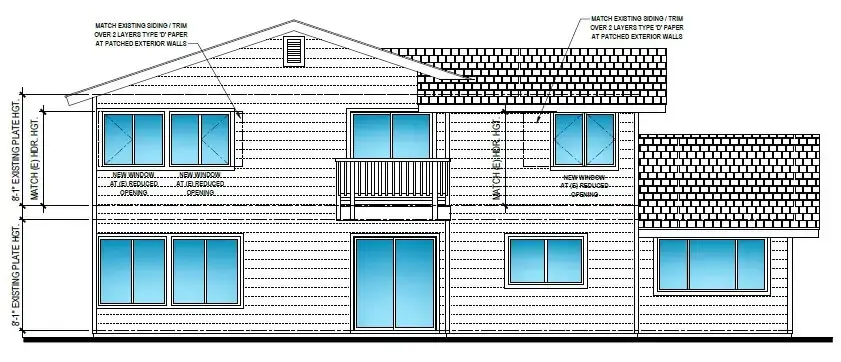
An addition that is structurally sound but architecturally inconsistent will often feel visually mismatched with the existing home and the surrounding neighborhood. In a Preservation Zone, that lack of compatibility can also become a regulatory issue, meaning the design may not receive approval even if it meets all basic building code and engineering requirements.
What Preservation-Compliant Remodels Actually Require
In Fullerton’s historic districts, modifications to structures must be reviewed for compliance with the city’s preservation standards before permits can be issued. Incomplete or architecturally inconsistent submissions are among the most common causes of delay. Working with a design-build team that understands these standards from the outset — rather than discovering them at plan check — is the most effective way to keep your project on schedule and on budget.
What Sets Sea Pointe Apart for Fullerton Historical Home Remodels
Design and Construction Fully Integrated
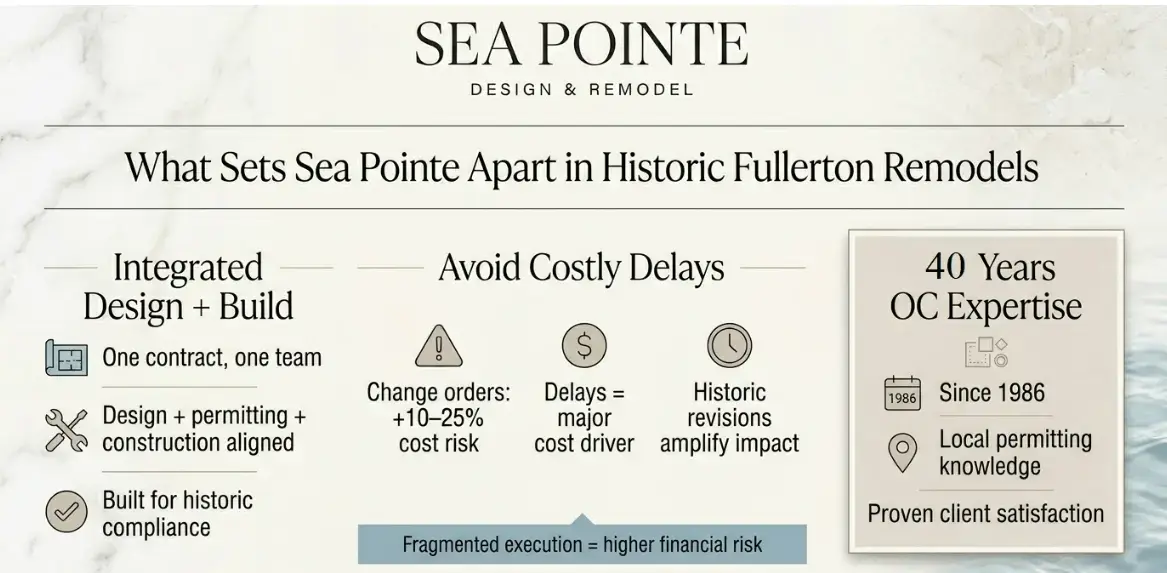
Most contractors offer construction but not design. Most designers offer vision but not construction management. Sea Pointe delivers both under a single contract, with one team managing architectural design, historic compliance, permitting, and construction from start to finish. For a historic remodel where design precision and regulatory compliance must be perfectly aligned, this integrated approach is essential.
The Financial Risk of Fragmented Execution
According to the National Association of Home Builders, change orders are a leading cause of budget overruns in residential construction, commonly adding 10–25% to total project costs.
Research from the U.S. Department of Housing and Urban Development similarly identifies project delays as a primary cost driver. In a historic remodel, design revisions triggered by preservation non-compliance can cascade through structural and permitting work — making fragmented execution especially costly.
40+ Years of Orange County Expertise
Sea Pointe has been crafting custom home remodels and expansions across Orange County since 1986. Our team brings deep familiarity with local permitting requirements, the specific demands of historically designated neighborhoods, and the design standards Southern California homeowners expect.
Clients consistently highlight Sea Pointe’s communication, attention to detail, and ability to deliver beyond expectations as what makes the experience genuinely different from working with a general contractor.
Schedule Your Complimentary Consultation
Ready to explore a remodel or expansion for your Fullerton historic home? Sea Pointe Design & Remodel makes it easy to take the first step. Schedule your complimentary in-home consultation, and a dedicated designer will visit your property, assess the existing structure and historic context, and begin developing a plan that honors your home’s character while delivering the modern space your family needs.
Call us on (949) 861-3400, visit our design showroom at 576 Wald, Irvine, CA 92618 (Monday–Friday, 9 am – 5 pm), or book online at seapointe.com.
Conclusion: Honoring the Past, Building for the Future
Fullerton’s historic homes are among Orange County’s most distinctive architectural assets — and the homeowners who live in them carry a responsibility to preserve what makes them special, even as they adapt them for modern life. A thoughtful remodel or expansion doesn’t diminish a historic home’s character. Done right, it deepens it.
Sea Pointe Design & Remodel brings over 40+ years of Orange County experience, a fully integrated design-and-build approach, and a genuine commitment to delivering remodels that exceed expectations — without sacrificing the character that makes your home worth remodeling in the first place. Call us on (949) 861-3400 or visit seapointe.com to schedule your complimentary in-home consultation today.
Does Sea Pointe have experience with historic home remodels in Fullerton's preservation zones?
Sea Pointe’s design-build team is experienced in working within preservation zone guidelines and historic review processes. We incorporate historic compliance requirements into the design from the outset — helping avoid the approval delays that come from submitting architecturally inconsistent plans.
What are Fullerton's Residential Preservation Zones, and do they affect my remodel?
Fullerton has designated 10 of its 16 historic districts as Residential Preservation Zones, where city design guidelines require additions and improvements to be architecturally compatible with the neighborhood’s historic character. If your property is within one of these zones, those guidelines apply to your project.
What is the Mills Act, and could my Fullerton home qualify?
The Mills Act offers property tax reductions to owners of qualifying historic properties who commit to maintaining their home’s historic character. Fullerton adopted its program in 2020. Sea Pointe can help you understand whether your property qualifies and how to structure your remodel to remain eligible.
How do I maintain my backsplash?
Regularly wipe your backsplash with a damp cloth and mild detergent to keep it clean. For textured or porous materials, use a soft brush for deeper cleaning.
Can a remodel jeopardize my Mills Act benefits?
Yes. Mills Act contracts require rehabilitation work to follow the Secretary of the Interior’s Standards for Rehabilitation. Additions or modifications that alter defining architectural features — façades, rooflines, or street-facing character — can put eligibility at risk. Early design alignment with preservation requirements protects your tax benefits.
How does historic preservation compliance affect the permitting timeline?
In Fullerton’s historic districts, modifications must be reviewed for architectural compatibility before permits are issued. Plans that don’t demonstrate compliance are a common cause of delay. Sea Pointe builds historic compliance into design documentation from the start — minimizing correction cycles and keeping projects on schedule.
Can I add square footage to a historic home in Fullerton?
Yes. Additions to historic homes are permitted, but must be designed to complement the architectural character of the existing structure. Sea Pointe’s designers are experienced in creating additions that feel architecturally continuous with original historic homes while delivering meaningful new square footage.