
Design-Build vs General Contractor vs Architect-Led: Which Path Fits Your Remodel?
One of the most consequential decisions an Orange County homeowner makes before a remodel isn’t about tile or cabinetry — it’s about who runs the project and how. The three most common delivery paths — design-build, general contractor, and architect-led — produce fundamentally different experiences in terms of communication, accountability, cost control, and timeline.
Choosing the wrong one for your project type is one of the most common sources of remodeling frustration, and it’s a decision most homeowners make without fully understanding what each model actually involves. Sea Pointe Design & Remodel has operated as an integrated design-build firm since 1986 — and that’s a deliberate choice, not a default.
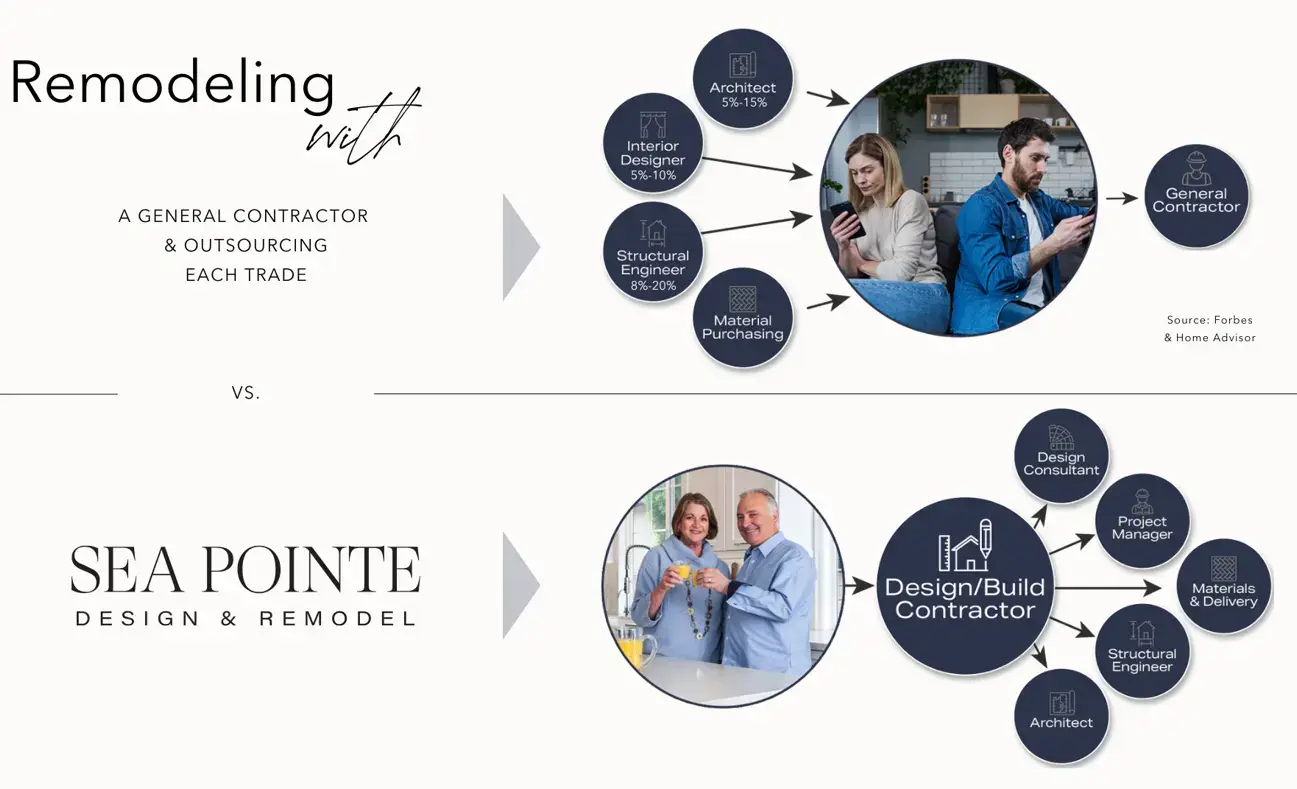
The General Contractor Model
How It Works
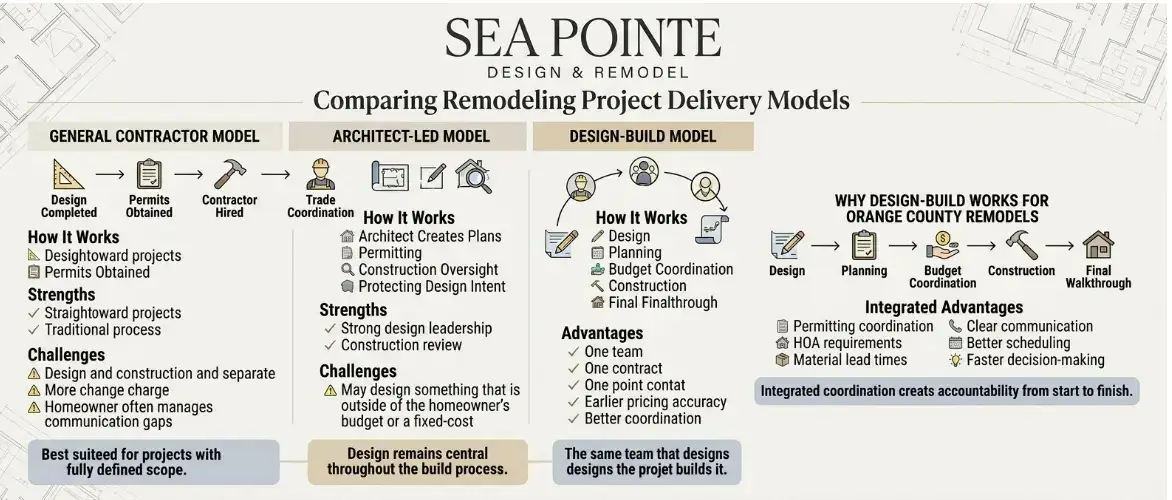
A general contractor (GC) is hired to manage construction after the design is complete. The homeowner — or a separate architect — produces the drawings, and then the GC bids on and executes the build. The GC coordinates subcontractors for plumbing, electrical, framing, tile, and other trades. The homeowner then serves as the on-site manager responsible for project coordination. It’s best to have the contractor pull the permit so the homeowner is not responsible for the work if anything goes sideways.
Where It Works — and Where It Doesn’t
The GC model performs well for straightforward builds where design is fully resolved before construction begins and scope is unlikely to change. Its core weakness is accountability: when design and construction are separate, gaps between what was drawn and what’s buildable often surface mid-project.
Change orders, delays, and disputes land in a gray zone between the designer’s responsibility and the contractor’s — and the homeowner typically ends up managing that and paying more later out-of-pocket gap themselves.
The Architect-Led Model
How It Works
In an architect-led project, a licensed architect drives both design and construction oversight. The architect can design plans for the contractor to build, however, this does not necessarily mean the homeowner can afford what the contractor will charge to build the project. Revisions can be costly and the homeowner ends up being the middle-man between the Architect and Contractor.
The Design-Build Model
How It Works
A design-build firm integrates design and construction under one roof with one team and one point of accountability. Designers, project managers, and builders work together from the initial consultation through the final walkthrough — meaning design decisions are made with construction realities in mind from day one, and the same team that drew the plans builds them.
Why It Works Better for Most Orange County Remodels
The design-build model’s core advantage is accountability. One contract means one point of contact for every question, decision, and concern throughout the project. It also enables more accurate pricing earlier in the process — because the builders are involved in the design phase, cost implications surface before they’re committed to paper rather than after they’ve been permitted.
For residential remodels in Orange County — where permitting complexity, HOA requirements, and material lead times all intersect — this integrated coordination is a structural advantage, not just a convenience. Learn more about what design-build means in practice on our website.
Where Each Model Breaks Down: A Breakdown Point Analysis
The GC Model’s Breaking Point
A remodel rarely fails because of materials or craftsmanship alone — it fails at specific breakdown points where the delivery model stops matching reality. In a GC model, the system typically breaks when design intent is incomplete or ambiguous at the moment construction begins. Because the builder executes plans created separately, gaps in documentation surface in the field as change orders and sequencing delays — and coordination responsibility shifts onto the homeowner.
The Architect-Led Model’s Breaking Point
In an architect-led model, the breakdown usually occurs later — when budget reality enters after design is complete. Once drawings go to bid, pricing feedback frequently reveals a gap between design ambition and market cost, forcing redesign cycles before construction even starts.
The DBIA’s 2025 Data Sourcebook reports that design-build projects are delivered 102% faster than traditional design-bid-build — a figure that reflects the cumulative time lost in these sequential handoffs.
The Design-Build Model’s Breaking Point
In a design-build model, the failure point shifts again: it occurs when early design constraints are locked in too rigidly before the client has had the chance to refine scope. Our five-phase process is specifically structured to front-load decisions in the design phase so that once construction starts, scope is fully resolved and the build can proceed without interruption.
According to DBIA research, design-build projects consistently outperform other delivery methods on both cost and schedule growth — a finding that holds across project types and economic cycles.
Which Model Is Right for Your Project?
The Honest Answer
The right choice depends on three variables: project complexity, your tolerance for managing the process yourself, and how important budget certainty is upfront. For new construction on a custom lot, or a landmark property with historic preservation requirements, an architect-led model may be the right call. For a straightforward cosmetic refresh with no structural work, a GC with existing drawings may be sufficient.
For Most Orange County Remodels
For the vast majority of residential remodels — kitchen transformations, primary bathroom overhauls, room additions, California Rooms, and whole-home renovations — design-build delivers the best combination of design quality, cost transparency, schedule certainty, and single-point accountability. It’s not a coincidence that over 50% of our projects come from referrals. Read those experiences on the written reviews page or through video testimonials.
Start with a Conversation, Not a Commitment
Sea Pointe offers complimentary in-home consultations where a designer visits your home, evaluates the project, and helps you understand what the process would look like — no cost, no obligation. You can also stop by the Sea Pointe design showroom at 576 Wald in Irvine to explore materials and finishes before making any decisions.

Call (949) 861-3400 or visit seapointe.com to schedule. Recognized by Houzz, the Orange County Register, and the BBB, Sea Pointe has spent nearly four decades building a reputation for design quality, process transparency, and client outcomes. Browse completed work in the full project portfolio to see the range and quality of finish firsthand.
One Team, One Contract, One Outcome
The delivery model you choose shapes every aspect of your remodeling experience — from how quickly you get a realistic budget to how smoothly construction runs to who picks up the phone when something needs to be resolved. For most Orange County homeowners undertaking a meaningful remodel, design-build offers the best combination of accountability, cost transparency, and design quality.
Sea Pointe Design & Remodel has been proving that for over 40 years. Their integrated design-build process, award-winning team, and all-inclusive pricing make the path from vision to finished project as clear and controlled as it can be.
Call (949) 861-3400 or schedule your complimentary in-home consultation today — and start your remodel with the right team from day one.
What is the main difference between design-build and a general contractor?
A general contractor manages construction after design is complete, typically working from drawings produced by a separate designer. Also, general contractors may also tell the homeowner to shop around town for materials while racking up costs that end up being outside of the original price point they told you your project would cost in the first place. A design-build firm integrates design and construction under one team and one contract. The key difference is where responsibility lives when design intent and field reality don’t match.
Is design-build more expensive than hiring a GC separately?
Not typically — and often less so when total project costs are considered. Design-build firms provide all-inclusive pricing with budget awareness built into the design phase, reducing the risk of discovering the project exceeds budget after architectural fees have already been paid. Sea Pointe’s value engineering approach actively aligns design decisions with the homeowner’s budget throughout the process.
Do I still need an architect if I use a design-build firm?
For most residential remodeling projects — kitchens, bathrooms, room additions, and whole-home renovations — a design-build firm handles all design, engineering, and permitting in-house without requiring a separate architect. Sea Pointe’s team includes designers, a Director of Planning and Architecture, and project managers who manage the full scope. See the remodeling FAQs for more detail.
When does an architect-led model actually make sense?
An architect-led model is most appropriate for new custom home construction, properties with historic preservation requirements, or projects with highly complex structural demands that require a licensed architect of record. For the majority of residential remodeling projects in Orange County, the architect-led model adds cost and timeline without a proportionate improvement in outcome.
How does design-build handle cost overruns differently than a GC model?
In a GC model, cost overruns often stem from mid-construction design conflicts — items not fully resolved in drawings that require change orders to fix in the field. Design-build reduces this risk because the builders are involved in the design phase and surface constructability issues before the project is permitted. Sea Pointe provides all-inclusive pricing after design, so there are no hidden costs once the contract is signed.
How does Sea Pointe's design-build process work from start to finish?
We follow a five-phase process: understanding your space, setting goals, designing the project, planning and permitting, and construction. Designers and project managers work together from the first consultation through the final walkthrough, with weekly updates throughout the build. Every client has a single point of contact responsible for the entire project.
How do I know if design-build is the right fit for my specific project?
The best way to find out is a complimentary in-home consultation with us. A designer will visit your home, evaluate the scope, and give you an honest assessment of the right approach — including what the process, timeline, and budget would look like. Call (949) 861-3400 or visit seapointe.com to schedule.