SCHEDULE YOUR COMPLIMENTARY CONSULTATION

SCHEDULE YOUR CONSULTATION

"*" indicates required fields

This field is for validation purposes and should be left unchanged.
Optin

"*" indicates required fields

This field is for validation purposes and should be left unchanged.
Optin
Best of the Blog – Top Home Improvement Tips of 2016

Best of the Blog – Top Home Improvement Tips of 2016

We don’t have snow around here, but we can tell by the Christmas music that it’s time for our end-of-the-year wrap-up. Although it’s a compilation of some of the best tips of 2016, it is by no means a complete list of great home ideas. Be sure to check out our other blog posts to get more information about remodeling, design and DIY projects.

Without further ado, the best of 2016:

Best of the Blog - Top Tips of 2016 | Sea Pointe Design & Remodel

Kitchen:

Lighting

Lighting is an area where a modern update can be a wise move aesthetically, and reduce your power bills. Whether you want to replace existing light fixtures with those featuring sleeker lines and more contemporary finishes or you want to install recessed lights to replace outdated overhead fixtures, LED options offer attractive illumination and considerable energy savings.

Cabinets

Kitchen cabinets often represent the single most costly item in a kitchen remodel. A custom cabinet design can help make the most of your kitchen, creating an efficient and attractive space for you enjoy as you cook and offering you nearly unlimited options as to style, material, and finish. This blog post tells you exactly what you should keep in mind as you pick out new cabinets.

Appliances

Your refrigerator doesn’t have to be avocado green to feel like a relic from the past. Replacing your aged appliances can offer benefits beyond sprucing up your kitchen with a modern look, however. Modern appliances are continually improving in energy efficiency and convenient features unavailable even a few years ago, so an upgrade here can lower your utility bills as well as enhance your enjoyment of your kitchen.

Bath:

Shower Design

The shower is one of the largest elements in your bathroom, so its design deserves some careful thought. You want a shower that both reflects your personal style and complements the overall bathroom design. Fortunately, there are many design options that can make your shower a beautiful feature instead of merely a convenient spot to get clean.

Whole House:

Flooring

Natural hardwood floors are an understandably popular option in both traditional and modern homes. With different finishes, plank widths and lengths, and other options to choose from, wood offers a nearly endless range of beautiful looks from classic to cutting-edge. But with advances in construction and design, homeowners desiring wood floors have also been able to choose from engineered wood products as well as wood-look ceramic tiles that look just as beautiful as natural hardwood. See which one is the best for you.

Energy Efficiency

With the cost of water and electricity rising year by year, many homeowners take energy efficiency into serious consideration when deciding how to remodel their homes. Whether you’re primarily concerned with lowering your utility bills or with reducing your environmental footprint, you’ll be happy to know that energy-saving home improvements can also increase your comfort and improve both the aesthetics and resale value of your home.

Preparing for a Remodel

When you’re planning your home remodeling project, don’t forget to put some thought into how construction is going to affect your daily life, the rest of your home, and your nearby neighbors. Thinking ahead can help minimize disruptions, protect your furniture and belongings from harm, and keep the peace in your neighborhood.

Home Resale

Conventional wisdom says that homeowners tend to live in their houses about 7 years before they sell and move. Whether you intend to stay in your own home a longer or shorter period than that, you may be considering how the improvements you make might affect the resale value of your home down the road. Not all home improvements will give you the same return on investment, so you need to choose wisely if you want to boost the value of your home without overspending.

We are looking forward to all of the home improvement projects planned for 2017. Happy holidays!

Let's Discuss Your Next Project!

  • This field is for validation purposes and should be left unchanged.
  • We guarantee 100% privacy for all information!


Best of the Blog – Top Home Improvement Tips of 2016 was last modified: December 18th, 2025 by Smart Marketing
The Ultimate Guide to Choosing the Right Wood Flooring for Your Home

The Ultimate Guide to Choosing the Right Wood Flooring for Your Home

Wood flooring is a timeless and versatile choice that can elevate the beauty and value of your home. With numerous options available, from natural hardwood to wood-look alternatives, selecting the right flooring can feel overwhelming. Here, we’ll explore the different types of wood flooring, the pros and cons of each, and how to choose the best option for your home with the help of a design expert at Sea Pointe Design & Remodel.

White-built-in-cabinet-kitchen-storage

Types of Wood Flooring

1. Natural Hardwood Flooring

Natural hardwood floors are made from solid wood planks and are available in a variety of species, including oak, maple, and walnut.

Pros:

  • Incredibly durable and long-lasting
  • Can be sanded and refinished multiple times
  • Adds value and elegance to a home
  • Feels comfortable and warm underfoot
  • Available in various finishes and stain colors

Cons:

  • Susceptible to moisture and humidity changes
  • Can be expensive compared to other options
  • Requires regular maintenance to prevent or repair scratches and wear
  • Can only be installed in above-ground rooms and over wood subfloor

maple-wood-blair-style-shaker-cabinets-amalfi-blue

2. Engineered Wood Flooring

Engineered wood consists of a top layer of natural wood adhered to multiple layers of plywood or fiberboard for added stability.

Pros:

  • More resistant to moisture and humidity than solid hardwood
  • Less expensive than natural hardwood
  • Available in a wide variety of styles and finishes
  • Easier to install, with options for floating, glue-down, or nail-down methods
  • Can be installed over both wood and concrete subfloors

Cons:

  • Still susceptible to scratches but cannot be refinished as many times as natural hardwood flooring
  • Quality varies depending on the thickness of the top wood layer
  • Some lower-quality options may not be as durable

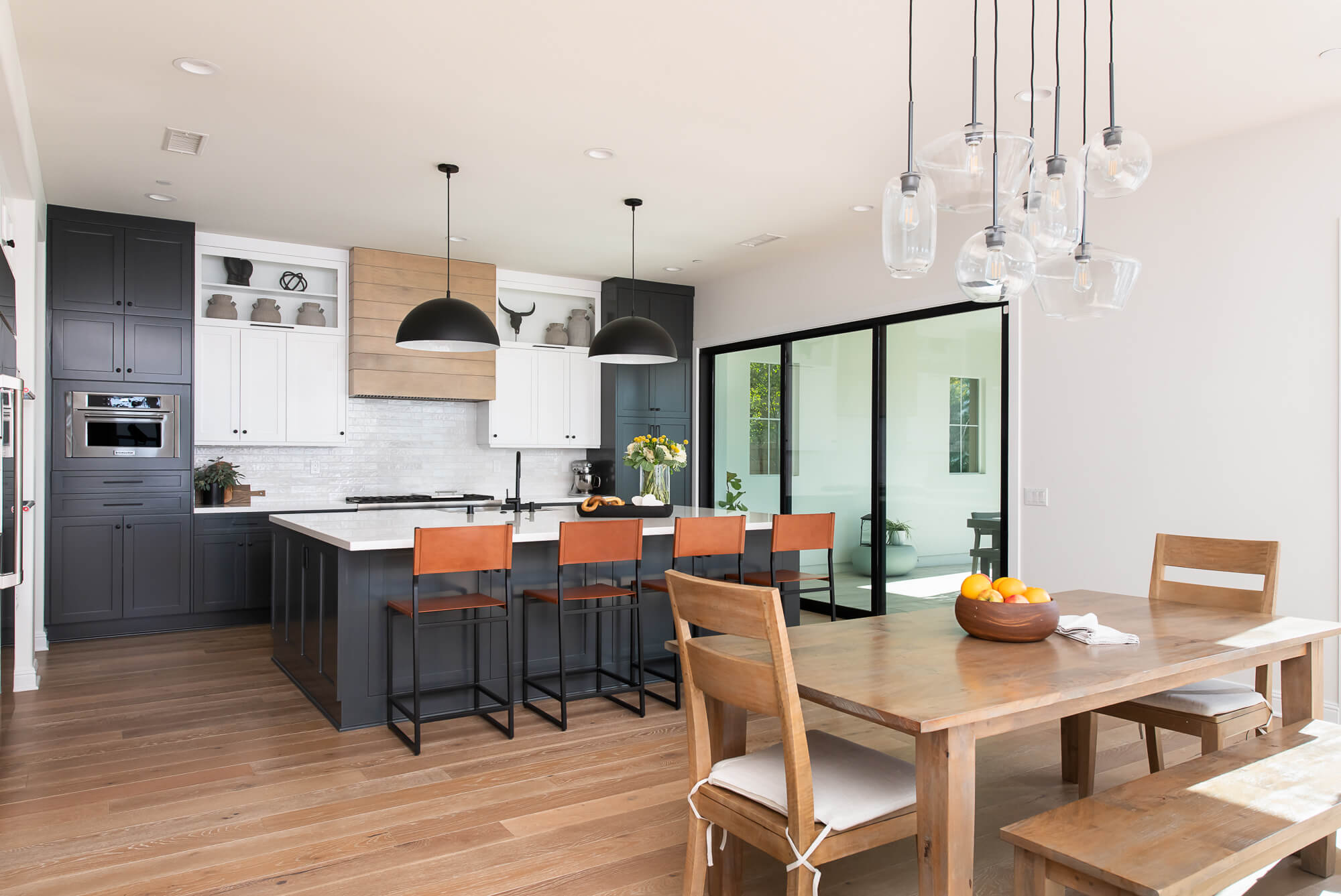
In this Irvine whole home remodel, engineered European Oak wood flooring is moisture-resistant and holds up well under daily foot traffic.

remodeled-fireplace-stairway-custom-cabinetry

3. Luxury Vinyl Plank (LVP) Flooring

Luxury vinyl plank flooring is a synthetic alternative that mimics the appearance of wood while offering superior durability and water resistance.

Pros:

  • 100% waterproof, making it ideal for kitchens and bathrooms
  • Scratch-resistant and low-maintenance
  • More affordable than hardwood or engineered wood flooring options
  • Available in a wide range of wood-look designs

Cons:

  • Does not add the same value as real wood flooring
  • Some lower-end products may feel less authentic
  • Cannot be refinished

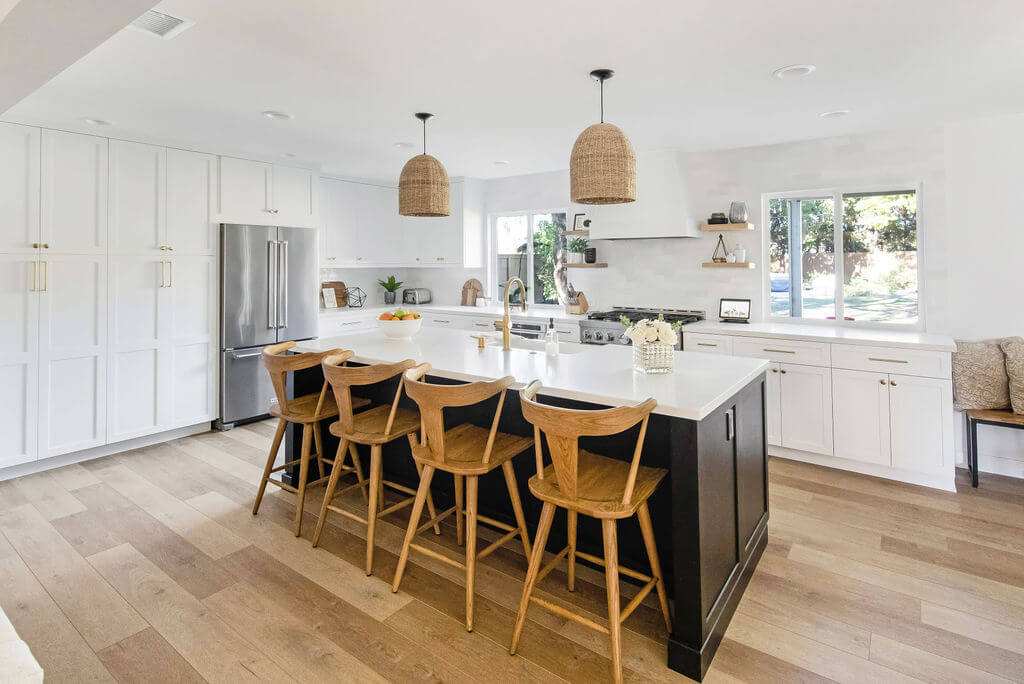
In this Dana Point kitchen remodel, LVP flooring complements the coastal color palette, providing a durable and elegant finish.

260-sq-ft-kitchen-remodel

4. Laminate Wood Flooring

Laminate flooring is a multi-layered synthetic product designed to replicate the appearance of wood.

Pros:

  • Budget-friendly alternative to hardwood
  • Scratch- and fade-resistant
  • Easy to install with a click-lock system
  • Low maintenance

Cons:

Not waterproof – excessive moisture can cause warping
Cannot be refinished
Does not offer the same luxury feel as real wood

5. Ceramic Wood-Look Tile

Ceramic or porcelain tile is designed to resemble wood while offering the benefits of tile flooring.

Pros:

  • Completely waterproof, ideal for bathrooms and kitchens
  • Extremely durable and resistant to scratches and dents
  • Low maintenance and easy-to-clean
  • Wide range of colors and textures available

Cons:

  • Hard surface may feel less comfortable underfoot
  • More difficult and costly to install
  • Can be cold in cooler climates without underfloor heating

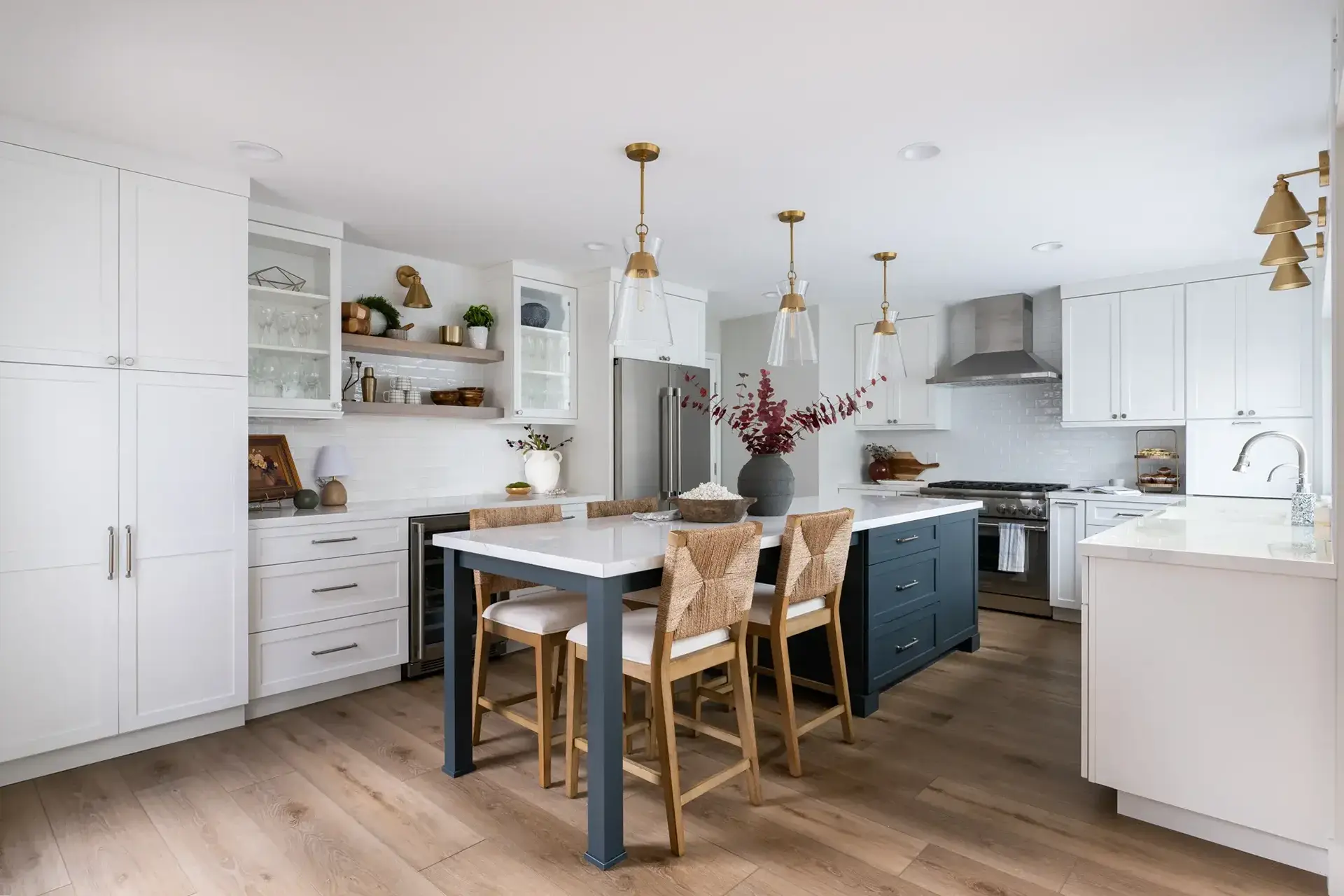
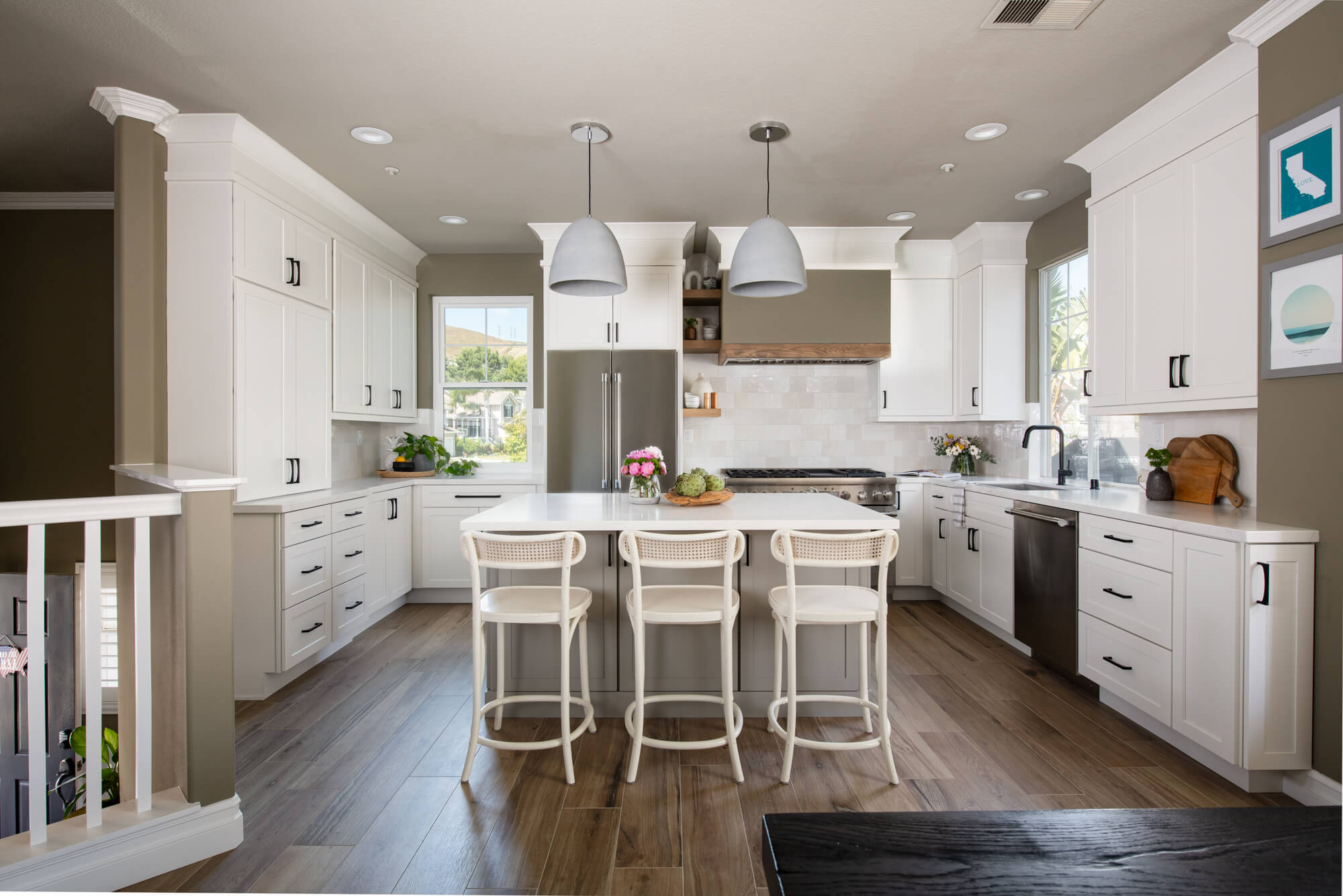
In this San Clemente kitchen remodel, Elysium porcelain plank flooring looks just like wood and adds to the overall modern farmhouse feel.

Elysium-porcelain-plank-flooring-in-Planches-Noisette

How to Choose the Right Wood Flooring for Your Home

With so many options available, how do you decide which type of wood flooring is best for your home? Consider the following factors:

1. Lifestyle & Household Needs: If you have pets, children, or high foot traffic, a durable and scratch-resistant option like LVP or engineered wood may be ideal.

2. Budget: Solid hardwood is a premium option, while laminate and LVP offer budget-friendly alternatives without compromising style.

3. Moisture Resistance: In areas prone to moisture, such as kitchens and bathrooms, ceramic wood-look tile or LVP is the best choice.

4. Aesthetic Preferences: Consider the flooring’s look, texture, and color to match your interior design style.

5. Long-Term Investment: Hardwood floors add long-term value to your home, while synthetic alternatives provide cost-effective solutions.

gut-and-remodel-new-kitchen

Work with a Design Expert at Sea Pointe Design & Remodel

Choosing the perfect wood flooring for your home involves balancing aesthetics, functionality, and budget. At Sea Pointe Design & Remodel, our experienced design professionals can help you navigate the options and select the flooring that best fits your needs and style. From classic hardwood to modern wood-look alternatives, we ensure you make the right choice for a beautiful and lasting result.

Contact us today to schedule a consultation and take the first step toward transforming your home with the perfect wood flooring!

Let's Discuss Your Next Project!

  • This field is for validation purposes and should be left unchanged.
  • We guarantee 100% privacy for all information!


The Ultimate Guide to Choosing the Right Wood Flooring for Your Home was last modified: December 18th, 2025 by Smart Marketing
Top 5 Energy-Saving Home Improvements

Top 5 Energy-Saving Home Improvements

With the cost of water and electricity rising year by year, many homeowners take energy efficiency into serious consideration when deciding how to remodel their homes. Whether you’re primarily concerned with lowering your utility bills or with reducing your environmental footprint, you’ll be happy to know that energy-saving home improvements can also increase your comfort and improve both the aesthetics and resale value of your home. Some of the top energy-saving home improvements are:

Top 5 Energy-Saving Home Improvements | Sea Pointe Design & Remodel

1. Sealing and insulating: Sealing the outside envelope of your home from drafts is an essential first step in saving energy. This may also include replacing exterior doors with new, better-insulated ones, which can also improve your home’s curb appeal. It’s also important to seal up any leaks from your ductwork that may be venting cool or warm air into spaces that don’t need it. Finally, adding insulation in attic spaces and walls will help keep your house warm in winter and cool in summer without having to overwork your HVAC unit.

2. Low flow fixtures: With new improvements in low-flow technology, adding low-flow shower heads, toilets, and faucets no longer means sacrificing comfort for water savings. These additions can mean significant savings not only on your water bill but also on your energy bill, as you can enjoy the same hot, luxurious shower you always have without using nearly as much water.

3. Energy efficient HVAC with programmable thermostat: An older heating and air conditioning unit can be one of the worst energy hogs in a home. A modern, energy-efficient unit coupled with a programmable thermostat can lower your utility bills considerably while keeping you in comfort. The newest thermostats on the market can even be adjusted remotely by smartphone, giving you instant control over your energy usage.

4. Updating appliances: As with HVAC units, energy-intensive appliances such as refrigerators, dishwashers, washing machines and dryers have improved considerably in both energy and water use over the years. In particular, an old refrigerator is a smart bet to replace—new stricter Energy Star guidelines for refrigerators came into effect in 2014, and as an appliance that runs 24-7 and typically lasts 15 to 20 years, a refrigerator represents a significant chunk of a home’s energy usage. Newer appliances also typically offer updated features and improved performance over their older counterparts.

5. Replacement windows: New energy-efficient windows don’t just offer energy savings, they can also significantly improve the look of your home. Double-paned windows help to eliminate energy loss through drafts and heat transfer, and special coatings can help control heat loss or gain through the windows, depending on the season.

To determine the best energy-saving upgrades for your home, it’s a good idea to consult with a remodeling company experienced in evaluating the overall needs of your home and formulating a strategy to maximize energy efficiency and lower consumption. To find out how you can incorporate smart energy-saving upgrades into your next remodeling project, contact the experts at Sea Pointe Design & Remodel today.

Let's Discuss Your Next Project!

  • This field is for validation purposes and should be left unchanged.
  • We guarantee 100% privacy for all information!


Top 5 Energy-Saving Home Improvements was last modified: December 18th, 2025 by Smart Marketing
How Do I Legally Convert a Garage to a Usable Room?

How Do I Legally Convert a Garage to a Usable Room?

Free Standing Accessory Dwelling Unit

How to Legally Convert Your Garage to Living Space in Orange County, CA?

Accessory Dwelling Units (ADUs) have been referred to by many names over the years: granny flats, mother-in-law suites, garage conversion, backyard cottages, alternative man caves, bonus rooms, guest house, guest suite, and now with the new shelter in place, folks are adding these as home office space.  Regardless of what you call it, these are much needed and affordable options for additional space in southern California real estate.

In addition to having more space for your family, ADUs are also often used to save money or earn incremental money from your existing lot size.  You may consider saving money by building an ADU to house an aging loved one or even your teenager that was originally going off to college and now is sheltering in place with distance learning.  Provided this is for an aging loved one, you can consider the savings of assisted living starting at $5,000 monthly in Orange County, Ca.  You can add on nursing care at the level your loved one currently necessitates which may be only once a week or less.  This also keeps your loved one close to you and your family for socializing, engaging, and ensuring overall mental and physical health are being tended to.  You can also build for the aging senior using aging in place design which includes hand railings at important locations in your home, easy entry shower, and microwave drawers as well as storage lower as opposed to upper kitchen cabinets.

Consider the alternative of saving money with your distance learning college student.  You no longer have dorm room fees or off campus apartment rates, or college meal plans.  Now you have a disappointed young adult trying to distance learn in the same home you’re working from home and other children may be home distance learning as well.  Considering southern California dorm rates can be as high as $23,000 according to San Diego State 2020 on-campus dorm fees, this solution may double for saving money today and earning money on the space once your college graduate leaves the nest.

Make Additional Income with an ADU on your property

Making Money from an Accessory Dwelling Unit

Using your ADU as income is also very appealing in Orange County, Ca with the considerably high average monthly 1-bedroom rental being $1,800. That’s an additional $21,600 of income annually.  While that’s not quite as much as San Diego State charges for a dorm room, it’s still a considerable amount of auxiliary income that will continue to rise as property values and rental costs increase.  An attached garage converted to an ADU needs retrofitting but has less complexities than free standing as the construction is able to leverage existing structure, building up existing HVAC unit, and less power and plumbing lines that would need to be run underground.  An average attached garage ADU with retrofitting can be built for $110,000 and as you add amenities (specifically cabinetry and countertops adds cost), that price will climb.  If you finance the entire 110K for 30 years at 3.8% interest, your monthly payment would only be $513, netting you $1,87 monthly / $15,444 annually.  If you finance the entire amount for 15 years at 2%, your monthly payment would be $708, netting you $1,092 monthly / $13,104.  These are healthy auxiliary incomes that will keep increasing as time goes on.

Recent legislation that went into effect in January of 2020 makes it legal for ALL California residents to pursue ADUs on their property. Each city has local provisions that they may require in order to support the civil engineering plan for their city. This includes but not limited to access to viable parking if building this inside your existing parking garage, proximity to public transportation, space occupied ratio to unused lot space, and many more individual parameters unique to each city.  Because land development is now starting to be limited space, California is encouraging home owners to consider this to provide additional housing to current or new residents, thereby keeping more retail spending in California as well. Legislation has also negated reduced fees with utility companies to further incentivize home owners to build ADUs.

How do I legally convert my garage to living space?

While you should always consult your CPA before making a financial decision about real estate, the California government website notes that you will only pay increased taxes on the additional square footage that you build or improve. Therefore your existing home will not be re-assessed during the building of an ADU.  Your impact for improvement will be even smaller when converting your existing garage into living space.

For homeowners who feel like they could use a little more elbow room, converting their garage into living space may seem like the easiest, cheapest way to add an extra room onto their house. In Southern California especially, it may not seem like a big deal to leave your car parked in the driveway year-round to gain some extra space. However, converting your garage properly involves a lot more work than simply installing some drywall and carpeting, and doing it the wrong way can be an expensive and even dangerous feat on what may be your biggest single investment, your home.

Let us share some of the various considerations to think about before jumping into a project of this size. Many people think because it has laundry hook ups that it should be a cinch and fairly affordable. There is a lot more than water and electricity in one location to consider. Plenty of existing garages will need retrofitting for housing purposes. You will need to plumb and provide a new electrical box to support more outlets and more watts being used.  Check out the below details on further considerations.

Permits are required for most types of construction in California, and garage conversions are no exception. But permits are just the first step. You also need to take building ordinances into consideration as you are planning a conversion. For example, in both Orange County and Los Angeles County, homes are required to have a certain number of covered off-street parking spaces, so if you eliminate your existing garage you may be required to build another garage or carport to satisfy this requirement. Local setback ordinances present another potential complication—if the resulting room would be too close to the property line, the city may not issue a permit. It is best to know the full scope of what is required and what is possible before you and your contractor begin to draw up any plans.

Costa Mesa ADU

While illegal garage conversions are all too common, you should avoid the temptation to ask forgiveness instead of permission when contemplating such a project. If you’re caught by the city, as many homeowners are, fines for unpermitted work can mount up quickly, and the process of retroactively obtaining permits is likely to be more trouble than having the proper inspections during construction, as you will have to open up walls to allow the inspector to view any electrical or plumbing work. In some cases, the city may require you to convert the space back to a garage. Even if the city doesn’t find out, an unpermitted garage conversion may deter potential buyers should you try to sell your home. Permits exist for a reason and overall it’s to benefit the homeowner 2-fold; one is that the building is done to code and safe to live in and the other is that the person who takes the permits out is taking responsibility and liability for the work.  You don’t want your name on the permit unless you’re a licensed and insured general contractor. You also don’t want an uninsured construction professional making a claim on your homeowners insurance for getting injured on the job.  Remember permits keep you safe and are only for new construction as inspectors don’t  have time or interest in peeking around our property for un-permitted work.  Protect yourself and ensure your general contractor pulls these.

Converting a Garage into a Living Space

In a garage to general living space conversion, having the space’s existing electrical wiring evaluated should be towards the top of your list. Firstly, it is possible that the electrical wiring no longer meets building code which would require the rewiring work of a licensed electrician. Secondly, the standards set by the California Energy Commission’s “Title 24 – Building Energy Efficiency” will determine an acceptable lighting plan. This is easy with a professionals help.

Additional Living Space

While evaluating the existing state of the garage intended for conversion, it’s equally important to note whether or not there is a step between the garage floor and your homes existing living space. Such a step is most often found in attached garage units. According to the California construction building codes, in this situation you will need to level the garage flooring to be even with the home floor level.

When you work with a design build firm you will get the benefit of your Designer being an expert space planner with the ability to get multiple uses out of spaces that you may not consider.  You may make this a work and play area depending on the hour of the day. Office by day with room for guests, and a small kitchen and when work is over the family room opens up and snacks are served while the big screen opens up. Your designer can show you options that will fit your life and the benefits you’re looking to gain with additional living space.

ADU for auxillary living space

Converting a Garage into a Bedroom

Converting a garage to a bedroom space oftentimes entails many more building regulations and standards. While exploring your conversion possibilities, consider that Orange County homes are required to have a certain number of covered off-street parking spaces based upon a home’s square footage and/or number of bedrooms. Meaning that part of your garage conversion project will be adding an on-site parking space.

Along with the general living space, you’ll need to adhere to the electrical compliances outlined above, adhering to the required “egress” building code is imperative. Egress is creating a means of evacuation or escape should there be a fire or other life-threatening emergency. Egress is determined by the square footage and relevant location of a space. This will be enforced by your city’s building inspector.  You will also need to install the proper fire and carbon monoxide detectors required per square foot in your living space.

Accessory Dwelling Contractor in Orange County

Sea Pointe Construction works in all cities in Orange County, with its headquarters in Irvine, CA. We have great working relationships with the cities where we have approximately 30 jobs going concurrently at any time. When you’ve ready to investigate the parameters and restrictions your specific city has, contact us and we’ll help you determine what is possible.  Once we have the specifics, you’ll still need to keep in mind that you will need to make some major changes in order to make a space meant to store cars into a comfortable, attractive living area. Think electrical, insulation, drywall, HVAC, additional windows and/or doors—you not only need to meet whatever legal requirements there are for living spaces in your area, but you also want to make sure that your conversion blends with the overall look of your house. This will ensure that your conversion adds to the value and beauty of your home instead of detracting from it.

When you decide to take this project on, be sure you are working with a qualified and quality remodeler. You want experience so that they bumps and bruises are not learned on your dime. If you are a busy professional, you will want to work with a design build firm; design build firms have all construction professionals under one roof enabling you to have one point of responsibility and accountability. Your team of professionals include a designer, draftsmen, structural engineers, a project manager, skilled tradesmen, and carpenters. The phrase, “It takes a village” is especially true when building a home. Another benefit of using a design build firm is their ability to deliver value-engineering.  This means they can leverage the different construction professionals knowledge longitudinally along the project; whereas traditionally you will have blueprints before you hire your contractor and therefore they will not be working together (nor do they want to). Value engineering enables the designer, the structural engineer, and the draftsman to collaborate to deliver the most cost effective solution based on your properties existing conditions and city limitations.

If you’re looking to add some space to your home, the assistance of an experienced remodeling company is invaluable in helping you realize your dreams in the best possible way. Contact the experts at Sea Pointe Design & Remodel today to explore the possibilities.

Q: Can I build an ADU attached to my house that is not my garage?

A: Yes, you can build an ADU that is attached to your home with a separate entrance.  This is often done in the east coast with family members living above or below each other.  You can take advantage of some existing electrical and plumbing but will still have retrofitting and additional reinforcements pending whether you build up or out.  

Q: Can I turn a shed into a legal living space?

A: No, you cannot turn a shed into legal living space as it will not meet city codes for several requirements, including electrical, plumbing, egress, foundation and suitable roof.  Sheds are not meant to be lived in and would not be approved by any city in Orange County for living purposes.

Q: How much does an ADU cost to build?

A: The cost of building an Accessory Dwelling Unit (ADU) varies significantly based on the chosen type, whether it’s a Junior ADU, detached, attached, above-garage, or a garage conversion. Converting an existing garage into an ADU involves several key modifications, including creating proper exits, upgrading the electrical system, leveling the flooring to match the main house, installing plumbing, drainage, HVAC, a kitchenette, a bathroom, and sleeping quarters. Alternatively, an office space can be created, which might reduce the need for a kitchenette and bathroom. Adding a pull-out couch can provide flexible guest space and potentially simplify the construction. It’s always best to consult a professional. Call us for a complimentary consultation at (949) 861-3400.

Q: How long does it take to build an ADU?

A: Much like cost this all depends on what type of ADU you are building. You could build a complete separate home in your backyard or a simple studio. Regardless of type, this is a major remodeling project and will not be done in under 2 months. We can custom design your ADU to the purpose you are seeking and build out a detailed timeline so you know exactly when completion will be done.

Let's Discuss Your Next Project!

  • This field is for validation purposes and should be left unchanged.
  • We guarantee 100% privacy for all information!


How Do I Legally Convert a Garage to a Usable Room? was last modified: December 11th, 2025 by Smart Marketing
Adding a Fireplace to Your Home

Adding a Fireplace to Your Home

A fireplace has positive associations for many homeowners—it’s an attractive focal point as well as a cozy, relaxing spot on a cool evening. Since many houses built in the last four decades have not included fireplaces, adding one is a popular update. Here’s what you need to know if you’re thinking about adding one to your home.

Adding a Fireplace to Your Home | Sea Pointe Design & Remodel

First of all, you need to be aware of local regulations. In Southern California, in both Orange and Los Angeles counties, you cannot add an open-hearth wood-burning fireplace to an existing home, due to air quality concerns. Thus any new open-hearth fireplace must have a gas or alcohol-fueled log set. Fortunately, there are a wealth of options for gas fireplaces in both traditional and modern looks, so this requirement shouldn’t discourage you.

Second, although a majority of home buyers consider a fireplace something that they would pay more to have, that’s only true up to a point. If you’re considering the impact adding a fireplace would have on your home’s resale value, the most advantageous placement is in a frequently used room such as a living room, family room, or great room, and the overall project should fit the style and quality of the rest of your home for the greatest appeal. This is probably not the project to consider if you’re looking for something to boost your home’s value immediately prior to a sale—rather, add a fireplace when you anticipate having the opportunity to enjoy it yourself for several years.

Adding a gas fireplace gives you a great deal of flexibility in both style and placement. While you can opt for a natural vent, which uses a metal chimney to vent air through the roof, direct-vent technology can vent the exhaust from your fireplace to the outside through an exterior wall. This means you can consider design options that would not be possible with a traditional fireplace, such as having a window above the fireplace. Prefabricated fireplaces, which are lightweight and highly insulated, can be installed very close to framing and other combustible materials, also adding to design flexibility. Consult with an expert, who can give you the most up-to-date information on what’s available and give you recommendations for your home.

The design options for fireplaces run the gamut from traditional to ultra-modern. You can opt for a traditional hearth and a wooden mantel with a brick or tile surround framing a realistic gas log that mimics the look of a wood fire, or you can choose a sleek modern fireplace surrounded by granite and flames leaping out of a bed of fireplace glass or river rocks. You can have a fireplace with glass on both sides, offering a view through to the next room. There is truly no limit to the customized look you can achieve for your own home.

If a fireplace is the perfect touch your home needs, contact the experts at Sea Pointe Design & Remodel today. We can help turn your dreams into beautiful reality.

Let's Discuss Your Next Project!

  • This field is for validation purposes and should be left unchanged.
  • We guarantee 100% privacy for all information!


Adding a Fireplace to Your Home was last modified: December 18th, 2025 by Smart Marketing